Tuesday, November 16, 2021

Augustine and His Kin

“What do people mean by being baptized on behalf of the dead? If the dead are not raised at all, why are people baptized on their behalf”  (1 Corinthians 15:29).

“I have no idea what this text means., Augustine wrote in a commentary on 1 Corinthians 15,and in reference to Paul’s phrase, “baptized on behalf of the dead."


To be Augustinian is to approach the scriptures with full awareness that we “know in part,” to never allow our certitude (how sure we are) to outstrip our certainty (how sure a thing is).


John Calvin, said, “Let this be our sacred rule: to seek to know nothing except what scripture teaches us; when the Lord closes his holy mouth, let us go no further.” Or, as Paul would say, let's not “go beyond what is written” (1 Corinthians 4:6).


I’m told that one evening after dinner at one of the Oxford colleges, a porter handed an English Lord his hat. “How did you know it was mine?” the Lord asked. “I didn’t,” the porter responded, “I just knew it was the one you came in with.”


Bully for him: A steady refusal to go beyond the facts.


David Roper
11.16.21

Wednesday, November 10, 2021

Working Together With God


"God reconciled us to himself throughChrist, and has given us the ministry of reconciliation…  In this way, we are working together with God" (2Corinthians 5:18, 6:1). 

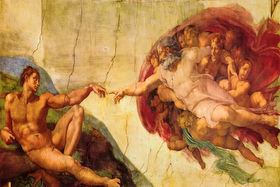
Imagine that you've been apprenticed to Michelangelo, the creative genius and celebrated Renaissance artist. You're a novice, but he has invited you to participate with him in painting "The  Creation of  Adam" on the ceiling of the Sistine Chapel. Your assignment is to fill in a tiny portion of a fold in the drapery behind the form of the Creator. 

So you work for hours, lying on your back on a rickety, wooden scaffold, 65 feet off the chapel floor, wet lime plaster falling on your face and irritating your eyes, knowing that no one on earth will acknowledge your contribution. 

But you will have added to the beauty of the whole. The painting would be incomplete without you.  

Paul makes a remarkable statement in the text above, one easily lost in the misplaced chapter heading: "So then, we are working together with God." 

God alone has reconciled the world to himself in the Cross. Now he stands with arms wide open to receive all who will come. Yet, though he has done all to bring salvation to us, he has given you "the ministry of reconciliation," to those who come your way. The picture will be incomplete without you. 

"But, I'm old," you say—or a house-bound invalid, a hard-pressed mother, a weary care-giver, a retired pastor with time on his, or her hands. “I'm out of the picture. What part can I play?"

You can love and you can pray—mighty works as it happens, when you're working together with God.

David Roper
11.10.22


Monday, November 8, 2021

Feed My Lambs

“Simon, son of John, do you love me? Feed my lambs…” (John 21:13)

In 1627, Samuel Rutherford penned a letter to Marion M'Naught, wife of William Fullerton, minister of a small Presbyterian church in Kirkcudbright, Scotland. Things were not going well for William, and he had few to "speak a good word" for him. He wanted God to "transplant" him to another place, perhaps a larger place where his gifts would be acknowledged and better utilized.

Rutherford wrote, "All God's plants, set by His own hand, thrive well. Ask of God a submissive heart. Continue for the love of the Prince of your salvation, who is standing at the end of your way, holding up in His hand the prize and the garland to the race-runners. Your reward shall be with the Lord, although the people be not gathered (as the prophet speaks); and suppose the work do not prosper...you shall not lose your reward.”

Though the people be not gathered, "continue for the love of the Prince of your salvation.” Shepherd His lambs. Teach, pray, listen to their bleating and love them. Do it because you love Jesus “who is standing at the end of your way, holding up in His hand the prize and the garland to the race-runners.” 

Though “the work do not prosper...you shall not lose your reward.”

David Roper
11.8.21

Thursday, November 4, 2021

A Righteous Tree

Ancient Canaanite literature referred to evergreen trees as "righteous trees." (There's a reflection of that nomenclature in Isaiah 61:3 where the Servant of the Lord refers to the believing remnant of Judah as trees of righteousness, the planting of the LORD,") 

Evergreens don't drop their leaves and lose their shape in the winter, and they keep their verdure and foliage all year long. Thus in ancient times they were considered "righteous" because they always looked like trees—trees as trees are supposed to be.   

Righteousness these days is associated with fusty, finger-wagging prudes who are “good” in the worst sort of way, but ancient etymology belies that meaning: Personal righteous is "being what a man or women is supposed to be."

We all have vestigial memories of what we’re supposed to be. It’s that idea—it exists in the worst of us—that makes us want to be better.

C.S. Lewis (I think it was) once said that you can slap an alligator on the back and say "Be an alligator" and he will be unmoved by your entreaty. But clap a man on the back and say "Be a man"and he will know exactly what mean. (This was written before the age of gender sensitivity.) 

This is the righteousness that Jesus has promised to all who seek it and ask it of hm: “Blessed are those who hunger and thirst for righteousness, for they shall be satisfied" (Matthew 5:6). 

David Roper
11.4.21

Hope Floats

"Love bears all things, believes all things, hopes all things, endures all things" (1Corinthians 13:7).

No human being is hopeless. Only demons are hopeless, for their character is fixed for all eternity. Everyone else deserves the benefit of doubt.

Love is a refusal to give up on others; to take failure as final. It sees promise and looks for progress, no matter how slight. It prays and hopes and waits for ultimate triumph through the grace of God. 

A friend of mine once mused that he'd rather have it said that he loved too many than that he loved too few. Indeed, we may love too many, be fooled by pretense and our hearts may be broken, but, it's better to be less like Lucy, and more like Charlie Brown.


David Roper
11.3.21

Thursday, October 21, 2021

Lessons from the Lord of the Flies

 One day Ahaziah fell through the balcony railing on the rooftop of his house in Samaria and was injured. He sent messengers off to consult Baal-Zebub, (the Lord of the Flies) the god of Ekron, "Am I going to recover from this accident?" GOD's angel spoke to Elijah the Tishbite: "Up on your feet! Go out and meet the messengers of the king of Samaria with this word, 'Is it because there's no God in Israel that you're running off to consult Baal-Zebub god of Ekron?” (2 Kings 1:2,3).

---

I wonder why we in the Church so often “run off to consult" those who know nothing of "the wisdom from above" (James 3:17), who do not know that "the fear of (reverence for) the Lord is the beginning of wisdom"? (Psalm 111:10).

We're too often dazzled by credentials and technical jargon and the certainty with which earth-bound mavens express their convictions, and we uncritically accept their counsel without laying it alongside God's word for analysis. We do not "test the spirits"—look into the hidden presuppositions and philosophical underpinnings of every system to see if they are of God (1 John 4:1-6). Only too late do we realize that we've embraced a "wisdom that has not come down from above," but is "earthly, unspiritual, and demonic" (James 3:15).

Paul writes, "We have plenty of wisdom to pass on to you…but it’s not popular wisdom, the fashionable wisdom of high-priced experts that will be out-of-date in a year or so. God’s wisdom is something mysterious that goes deep into the interior of his purposes. You don’t find it lying around on the surface. It’s not the latest message, but more like the oldest—what God determined as the way to bring out his best in us, long before we ever arrived on the scene. The experts of our day haven’t a clue about what this eternal plan is. If they had, they wouldn’t have killed the Master of Life on a cross. That’s why we have this Scripture text: 'No one’s ever seen or heard anything like this, Never so much as imagined anything quite like it— What God has arranged for those who love him.' But you’ve seen and heard it because God by his Spirit has brought it all out into the open before you. The Spirit, not content to flit around on the surface, dives into the depths of God, and brings out what God planned all along. Who ever knows what you’re thinking and planning except you yourself? The same with God—except that he not only knows what he’s thinking, but he lets us in on it. God offers a full report on the gifts of life and salvation that he is giving us. We don’t have to rely on the world’s guesses and opinions. We didn’t learn this by reading books or going to school; we learned it from God, who taught us person-to-person through Jesus, and we’re passing it on to you in the same firsthand, personal way" (2 Corinthians 2:13-17, The Message).

Is it because there's no God in the Church that we inquire elsewhere? Elijah’s last words to Ahaziah should cause us to pause: “Because you consulted Baal-Zebub, Ahaziah, you shall surely die” (2 Kings 1:6). 

David Roper
10.21.21

Sunday, October 17, 2021

When God Gives In


They only cared about pleasing themselves…
And provoked God with their insistent demands.
So He gave them exactly what they asked for—
but with it they got an empty heart.  —Psalm 106:14-15 (The Message)

Psalm 106 is a catalogue of moral failure, summed up in a laconic confession: "We sinned a lot” (106:6).

 Out of this litany of bad behavior, one verse caught my eye: “(God) gave them (Israel) exactly what they asked for, but with it they got an empty heart” (106:15).

The incident the poet had in mind is described in the book of Numbers: “The riff-raff among the people had a craving and soon they had the People of Israel whining, ‘Why can't we have meat? We ate fish in Egypt—and got it free!—to say nothing of the cucumbers and melons, the leeks and onions and garlic. But nothing tastes good out here; all we get is manna, manna, manna’ (11:4-5). 

"Where's the meat?" the people of GOD cried. “Why can’t we go back to Egypt and have the good life we enjoyed there?” (How soon we forget.)

Moses replied, “You want meat do you? Well, God’s going to give you meat. You're going to eat meat, not for a day or two days, or five or ten or twenty days but for a whole month. You're going to eat meat until its coming out of your nose. You're going to be so sick of meat that you'll gag and throw up at the mere sight of it”— which is exactly what happened. (You can read the story for yourself in Numbers 11.)

What's the point? Well, if I want something my Father in Heaven does not want for me—because in His infinite wisdom He knows it would be ruinous—and I want it bad enough, and keep asking for it, He may give it to me, but the result will be emptiness and self-loathing.

 So then, I must be careful about what I want because, in the end, I may not want what I wanted at all. 

God's "giving in" is always redemptive, however, designed to turn us around and give us the truly good life. It was the pig pen, you know, that turned the Prodigal toward home.

 David Roper
10.17.21

Going and Not Knowing

"By faith Abraham obeyed when he was called to go out to a place that he was to receive as an inheritance. And he went out, not knowing...