Monday, July 12, 2021

Rough Men and the Ring of Gyges

“People sleep peacefully in their beds at night only because rough men stand ready to do violence on their behalf.”—George Orwell
 
There is a tale, “The Ring of Gyges,” that comes from Plato’s Republic. One of Socrates’ students, a man named Glaucon, offered the story in response to a lesson by Socrates, who argued that people are basically good and will do the right thing if they know the right thing to do. (“Give people light and they will find their own way” is the post-modern equivalent.)
 
Glaucon disagreed, and told a story about a shepherd, Gyges, who stumbled upon a cave with a corpse inside that was wearing a magic ring. When Gyges put on the ring, it made him invisible. (Tolkien, of course, had this story in mind when he wrote The Lord of the Rings.) With no one to monitor his behavior, Gyges went on a personal crime spree, unfettered by the law and its custodians
 
Glaucon’s story poses a question: Will we resist the temptation to do evil if we know that our actions will not be observed and restrained? Glaucon was convinced that we will not. In that, he was in line with all the biblical writers, who insist that there is in every one of us a tendency to do evil and unless that tendency is restrained it will express itself in acts of evil (Romans 3:23). Thus, there is a need for “rough men” to protect us from the evil in us and in others. 
 
So Peter writes, “Submit yourselves to every ordinance of man for the Lord’s sake, whether to the king as supreme, or to governors, as to those who are sent by him for the punishment of evildoers and for the praise of those who do good” (1 Peter 2:12-14).
 
Certainly, if the authorities compel us to act contrary to the will of God we must respectfully disobey. Furthermore, the authorities must themselves have restraints for the same forces that lead to lawlessness in us reside in them. But the concept of just authority is consistent with the biblical view of the depravity of the human race (Romans 3:23). To do away with these “rough men” who do violence on our behalf is to unleash the dark, spiritual forces of anarchy and terror.  “Do (we) really think (we) can stand upright in the winds that will blow then?” (Sir Thomas More).

 
David Roper
6.11.21


Tuesday, July 6, 2021

The Roots of Our Rage


A lion stepped before my eyes!
This one seemed to be coming straight for me,
His head held high,
His hunger hot with wrath…
 
—Dante, ”The Inferno” Canto 1
 
“Only by outraged pride[1] comes contention” (Proverbs 13:10).
 
When Dante begins his spiritual journey toward Paradise, he meets a lion “hot with wrath” impeding his way, a symbol of Dante's smoldering resentment
 
Dante was outraged by the injustice visited upon him by his political enemies. He was a rising star in the city of Florence, but his political ambitions were thwarted and he was forced into exile. He railed at the perfidy of those who wronged him—as were inclined to do.
 
Pride lies at the root of rageWe are indignant that anyone would stand in our way; that we should have to defer satisfaction; that we should have to suffer. We lash out at those who oppose us: “No one has the right to treat me this way,” we fume. “I will not be silent,” we shout, forgetting the silence of the Lamb who quietly bore injustice and prayed for those who debased him. 
 
We do have rights and when those rights are assailed anger is the normal reaction. The temptation to become angry and bitter is not sin, but it can quickly become sin if we allow it to linger. Temptation to sin can be redeemed by turning it into intercessory prayer (Matthew 5:44).
 
There is a place for righteous anger—moral outrage over injustice done to others—but for those who follow the Lamb, there is no place for bitterness when we have been unjustly treated. This the ”lion” that impedes our progress toward Christ-likeness. 
 
There may be righteous measures to redress a wrong, but we must do so in meekness and humility, and in quiet confidence in our Heavenly Father who alone “judges justly” (1 Peter 2:23). We can trust him; He will set things right in the end. 
 
David Roper
6.3.21

[1] The special Hebrew word for pride used here suggest the Rambo-like reaction of those who will not be “kicked around.”

Friday, July 2, 2021

Hyper-Seeing

 “How could you love such an ugly, ill-tempered, rude, hateful little wretch like me?” asked the little princess. “I saw through it all what you are going to be.” Said the wise woman, kissing her. “But remember, you have yet only begun to be what I saw” (George MacDonald).

There's a term sculptors use to describe the ability to look at a rough piece of stone and see it in its final, perfected form. It's called “hyper-seeing.”

Gutzon Borglum’s housekeeper captured the concept in her own quaint way when Borglum took her to Mt. Rushmore for the first time and she gazed up at the massive faces of the four presidents he had sculpted there: “Mr. Borglum,” she gasped, “How did you know Mr. Lincoln was in that rock?”

Hyper-seeing—is found first in God. He sees all that we are and more: He sees what we shall be when he has completed his work and we stand before him, holy and without blemish: the “splitting image” of Jesus.[i] The God who started this great work in you “will keep at it and bring it to a flourishing finish on the very day Jesus Christ appears!” (Philippians 1:6 The Message).

God will not be denied! He has such a longing for our perfection that nothing can or will remain an obstacle until he has finished the work he began long ago.

If only we will put ourselves in his hands. 

Doubt whispers, ‘Thou art such a blot;
He cannot love poor thee.’
If what I am He lovest not,
He loves what I shall be. —George MacDonald

David Roper

[i] "Evenness and symmetry are got by pairing the two split halves of the same tree, or branch. Hence the country saying: he's the ‘splitting image’—an exact likeness." Dorothy Hartley, Made in England (Cf., 1 John 3:2). 

Tuesday, June 29, 2021

Wherever You Go


60 years ago, in my seminary bookstore, I picked up a little volume entitled,Light on the Path. The stated purpose of the book is to help young pastors maintain their facility in the biblical languages in the face of the time-pressures of pastoral ministry.  Each day the book offers an Old Testament Hebrew text and an analogous New Testament Greek text, both of which we are encouraged to translate and ponder.
 
Here are the texts I found in this morning's readings and, with apologies to my old Greek and Hebrew professors, my translation:
 
Joshua 1:9
"Have I not commanded you? Be strong, take courage. Don’t be terrified, and don’t be shaken, for the Lord your God is with you wherever you go.”
 
Acts 28:15
"And the brothers there, when they heard about us, came as far as the Appian Market and the Three Taverns to meet us. On seeing them, Paul thanked God and took courage."
 
The author’s daily juxtaposition of the two verses is usually insightful, but, I asked myself, what on earth do these verses have in common?
 
Well...let’s look first at the Acts text and Luke's account of Paul's journey to Rome. Midway through the story, Luke informs us that Paul and his shipmates, having wintered on Malta, sailed on to Syracuse in Sicily, then to Reggio on the toe of the boot of Italy and finally up the west coast of Italy to the Bay of Naples. From there they faced an overland journey of 116 miles to Rome.
 
Paul had written a year or so before that he planned to visit Rome and the Christians there were awaiting his arrival. When they heard that he reached Naples, they dispatched a party down the Appian Way to meet him. Some traveled as far as the Three Taverns, on the 33rd milestone from Rome. Others trudged on to the Market of Appius on the 43rd milestone. (Somewhat like walking down Highway 84 from Boise, Idaho to Ontario, Oregon.)
 
In Paul’s day the region around Three Taverns and the Appian Market was an inhospitable bog much like Florida’s Okefenokee Swamp. Horace, a Roman Lyric poet who wrote 50 years before Luke, offered a lively picture of the discomforts of the region, mentioning the lack of adequate sleeping accommodations, the intolerable drinking water, the mosquitos, gnats and frogs which were "enemies to repose," and the exasperating procrastination of muleteers that dragged their boats through the swampy marsh  (Satires 1:5). Nevertheless, out of their love for Paul, this small party of Roman Christians trudged on.
 
Paul himself, having suffered ship wreck, snake bite and a dozen other indignities on his voyage must have approached the city of Rome with trepidation. He must appear before Nero’s tribunal. Would he be set free, or would he face imprisonment and death? 
 
Then he saw his friends in the distance, making their way toward him. "On seeing them,” Luke tells us, “Paul thanked God and took courage."
 
Quite often, God’s promise to “go with us wherever we go,” (Joshua 1:9) is best seen in the faces of brothers and sisters who, at considerable cost to themselves, come to walk with us through our troubles (Acts 18:15). We can thank God that He sends them and take courage from their love.
 
David Roper
6.29.21
 

Monday, June 28, 2021

The Great Awakening (Revelation 8)

"The first angel blew his trumpet, and there followed hail and fire, mixed with blood, and these were thrown upon the earth. And a third of the earth was burned up, and a third of the trees were burned up, and all green grass was burned up"(Revelation 8:7.)
 
Here in this chapter we hear the blast of four trumpets, warning of imminent danger. They precede the destruction of a third of the earth, the trees, the sea and its creatures, the rivers, and the atmosphere above. The fourth trumpet warns: “Woe, woe, woe to those who dwell on the earth” (8:13).
 
This is a pictorial representation of environmental disaster designed to awaken those whom John describes as “earth-dwellers”—those who look no further than Mother Earth for answers and take no thought of the One who made the heavens and the earth.
 
So-called natural disasters awaken us to our limitations and the folly of thinking we can control our environment and resolve the earth’s problems. Typhoons, tsunamis, tornados, earthquakes, volcanic eruptions, catastrophic flooding, forest fires, drought, pollution, pandemic and extreme heat, show us how helpless we are.
 
May these forces awaken us to give honor to the one who rules heaven and earth and whose voice commands the winds and seas (Mark 4:39). 
 
David Roper
6.28.21

Tuesday, June 22, 2021

Virtue-signaling

“When you do a good deed, do not sound a trumpet before you as the hypocrites do in the synagogues and in the streets, that they may have glory from men. Assuredly, I say to you, they have their reward" (Matthew 6:2).

Virtue-signaling is a newly-coined turn of phrase, referring to the efforts we make to be culturally correct in order to “have glory from men" (“Humblebrag," another neologism, more aptly describes the practice.) Jesus, on the other hand, said, ”Let your light so shine before men, that they may see your good deeds and gloify your Father in heaven" (Matthew 5:16).

"Letting your light shine," is not "doing good deeds," for that would be the opposite of Jesus’ intention. "Do good deeds, that others may see your good deeds”? That might bring glory to us, but how would it glorify our Father in heaven? 

No, we should allow Jesus, the light of the world, shine brightly so that others may know that our goodness is the product of His genius and not our own. If we don’t tell our friends and neighbors about Him they’ll think we’re just well-integrated folks with our feet on the ground, but they'll know nothing of their Savior.  It’s not enough to do good deeds. We must tell others that Jesus is the source of any goodness that they see in us. We must tell them so He can become their goodness as well. 

As I finished this piece I thought of a to-the-point satire by Joseph Bayly, written more than 60 years ago for His Magazine and entitled, “I Saw Gooley Fly.”  It was a story about a university student named Herb Gooley who returned from summer vacation with a new-found ability to fly. Literally. Like an eagle. 

Each morning Gooley flapped his arms and flew out of the second-story window of his fraternity house, spiraled into the air and soared off to his first class. His classmates observed these remarkable flights, marveled at them, and longed to fly like Gooley. But he never told them how. 

They only saw Gooley fly.

David Roper
6.23.21

Wednesday, June 16, 2021

E-Musing: Courage


"We take courage in God; for He will tread down our foes." —Psalm 108:13 

Psalm 108 is a hybrid psalm, a blending of two texts: Psalm 57:7-11 and Psalm 60:5-12. Both speak to those who are timid and afraid. The last line is the punch line: "We take courage in God…" (108:13).  
 
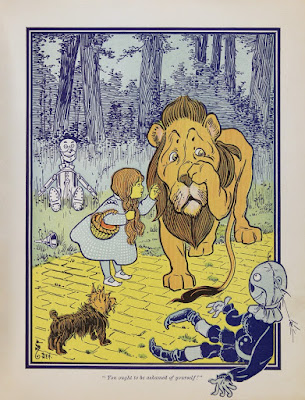
As a child I loved The Wizard of Oz and, being a quiet, shy child, I was drawn to the Cowardly Lion. In the end, as you know, the lion was given a medal for valor. “Look what it says," he exclaimed, "'COURAGE’. Ain’t it the truth, ain’t it the truth!”
 
Physical courage is one thing, but moral courage is another. Ofttimes, the hardest and bravest battles are fought within. Emily Dickinson wrote,  
 
To fight aloud is very brave, 
But gallanter, I know, 
Who charge within the bosom, 
The cavalry of woe.
 
Courage (or fortitude) is the name we give to this virtue. 
 
Courage is not simply one of the virtues, it's the virtue that gives strength to all the other virtues. Chastity, honesty, patience, mercy are hard-earned virtues in a world like ours, and hard to maintain. Courage enables us to persevere. 
 
Aquinas wrote, ”The principal act of fortitude is endurance, that is, to stand immovable in the midst of dangers.” Courage is "a long obedience in the right direction”; it is doing the right thing over the long haul despite the consequences. It is sticking with a difficult and demanding marriage; staying in a small place when prominence beckons; refusing to betray a moral principle to get along, or to get ahead; setting aside self-interest to serve the interest of others. We can do these things because God is with us, treading down the enemy of our souls. 
 
There’s a memorable scene in C.S. Lewis' The Last Battle, in which Jill Pole asks, What do you think is inside the stable? Who knows?” Tirian replies.  “Two Calormenes with drawn swords, as likely as not, one on each side of the door... There’s no knowing. But courage, child. We are all between the paws of the true Aslan."
 
Ain't it the truth! Ain’t it the truth!
 
David Roper
6.16.21
 

Going and Not Knowing

"By faith Abraham obeyed when he was called to go out to a place that he was to receive as an inheritance. And he went out, not knowing...