Wednesday, June 16, 2021

E-Musing: Courage


"We take courage in God; for He will tread down our foes." —Psalm 108:13 

Psalm 108 is a hybrid psalm, a blending of two texts: Psalm 57:7-11 and Psalm 60:5-12. Both speak to those who are timid and afraid. The last line is the punch line: "We take courage in God…" (108:13).  
 
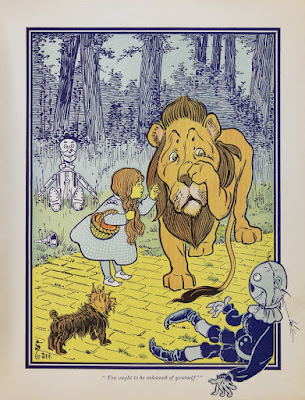
As a child I loved The Wizard of Oz and, being a quiet, shy child, I was drawn to the Cowardly Lion. In the end, as you know, the lion was given a medal for valor. “Look what it says," he exclaimed, "'COURAGE’. Ain’t it the truth, ain’t it the truth!”
 
Physical courage is one thing, but moral courage is another. Ofttimes, the hardest and bravest battles are fought within. Emily Dickinson wrote,  
 
To fight aloud is very brave, 
But gallanter, I know, 
Who charge within the bosom, 
The cavalry of woe.
 
Courage (or fortitude) is the name we give to this virtue. 
 
Courage is not simply one of the virtues, it's the virtue that gives strength to all the other virtues. Chastity, honesty, patience, mercy are hard-earned virtues in a world like ours, and hard to maintain. Courage enables us to persevere. 
 
Aquinas wrote, ”The principal act of fortitude is endurance, that is, to stand immovable in the midst of dangers.” Courage is "a long obedience in the right direction”; it is doing the right thing over the long haul despite the consequences. It is sticking with a difficult and demanding marriage; staying in a small place when prominence beckons; refusing to betray a moral principle to get along, or to get ahead; setting aside self-interest to serve the interest of others. We can do these things because God is with us, treading down the enemy of our souls. 
 
There’s a memorable scene in C.S. Lewis' The Last Battle, in which Jill Pole asks, “What do you think is inside the stable? Who knows?” Tirian replies.  “Two Calormenes with drawn swords, as likely as not, one on each side of the door... There’s no knowing. But courage, child. We are all between the paws of the true Aslan."
 
Ain't it the truth! Ain’t it the truth!
 
David Roper
6.16.21
 

Monday, June 14, 2021

The Fordson

It was in 1945, I think, that my father turned up one afternoon driving an ancient, rusted out, dented, Fordson tractor that he bought from a neighbor for a few hundred bucks. It was an unsightly piece of equipment and, in my opinion, should have been placed in the Smithsonian.

The tractor had outsized, spoked, steel rear wheels with metal lugs that evoked thoughts of WW1 German artillery pieces. It was powered (?) by a twenty horsepower, four cylinder, Ford engine  that sputtered, popped, backfired and generated great clouds of acrid black smoke. The little engine desperately needed an overhaul and required constant maintenance.

The tractor had no battery or starter, but used a magneto/coil ignition system that required hand cranking. It was hard to start in the summer, and next to impossible to start in the winter and could break your arm if the engined backfired and you weren’t wary. 

Once the engine got started, the only way to kill it was to retard the spark and wait for the engine to stall. The only way to brake it was to disengage the clutch and allow it to roll to a stop, a tricky expedient on hills. 

But the little tractor found a place in our hearts. My father used it to plow, pull stumps, power a circular saw and carry out a dozen useful tasks around our place. It was still in use when I left home, though my father had purchased a newer tractor. At last report the old Fordson was parked next to the barn, on light duty. 

My point, of course, is that old things aren't necessarily obsolete. As we get older we may not have the energy or the inclination to "go hard for God," but we can still be useful in our twilight years. 

So, if you're wondering what to do with yourself these days, just tell the Lord that you're willing to do whatever he asks you to do and put yourself at his disposal. Don’t worry; He'll find something useful for you to do.

David Roper
6.14.21

666

Loving a lie,
Not realizing in Adam, all die —Lauryn Hill

“Then I saw another beast coming up out of the earth, and he had two horns like a lamb and spoke like a dragon… He causes all, both small and great, rich and poor, free and slave, to receive a mark on their right hand or on their foreheads, and that no one may buy or sell except one who has the mark or the name of the beast, or the number of his name. This is wisdom. Let him who has understanding calculate the number of the beast, for it is the number of man: His number is 666” (Revelation 13:11, 16-18).

John is describing a religion of his day but also one that transcends the ages. 666  is with us today. 

666 Is a symbolic number, derived from the apocalyptic numerology of John’s day: 6 is the number of man. 3 is the number of God. 6 repeated 3 times stands for .”Man exalted as God.” This is Humanism,  Satan’s boldest lie: “You can be like God” (Genesis 3:5). This is the major religion of all time, the human compulsion to explain and solve the complexities of life apart from God. We can do it all by ourselves. 

Men and women devise systems that correctly define and diagnose the societal problems of the day but they always fall short for they do not understand “the mystery of iniquity,” a concept that can only be understood by revelation: Evil is deep and dark and far beyond human intervention. It can only be healed through the power and the wisdom of God

Paul writes, “Has not God made foolish the wisdom of this world? For since, in the wisdom of God, the world through wisdom did not know God, it pleased God through the foolishness of the message preached to save those who believe. For Jews request a sign, and Greeks seek after wisdom; but we preach Christ crucified, to the Jews a stumbling block and to the Greeks foolishness, but to those who are called, both Jews and Greeks, Christ the power of God and the wisdom of God. Because the foolishness of God is wiser than men, and the weakness of God is stronger than men.” (1Corinthians 1:20-25).

The  “wise” invent  well-meant schemes to deal with the inequities of our broken world and it’s systems, but all fail because they have no power to change the human heart. Tear down one racist, sexist, (ageist 😬) system and fallen men and women will erect another unjust system in its place. (History amply underscores this conclusion.) But where the cross has been preached and received, hearts are changed and, in time, inequities are righted. 

Only the “foolishness of God” can change human hearts and institutions. Thus “we preach Christ crucified: The power of God and the wisdom of God.

David Roper 

6.11.21


Tuesday, June 8, 2021

Systemic Evil

“In every institution, there is something which sooner or later works against the very purpose for which it came into existence” —C. S. Lewis
 
While I don’t embrace Critical Race Theory—its roots are antagonistic to the gospel—it is true that evil exists within systems. Patterns of sinful behavior and oppression can become entrenched and once these patterns are in place, they make it easier for individuals within that system to sin with impunity. 
 
But the Bible makes it very clear that we are responsible for our own sins (Deuteronomy 24:16). I may be the product of an ungodly family or a member of a corrupt organization, but systemic evil is never a rational for wrong-doing. I can, by God’s grace, resist the pressure to conform to unjust standards of behavior. 
 
Ezekiel 18 is a case study on what happens when we place our emphasis on corporate evil: It leads to individual moral irresponsibility: If I’m not answerable for my actions I can evade the consequences of those actions. But the scriptures make it clear that I am responsible for my actions no matter what others do. “The righteousness of the righteous shall be upon himself, and the wickedness of the wicked shall be upon himself” (Ezekiel 18:20).
 
Aleksandr Solzhenitsyn wrote, “The line separating good and evil passes not through states, nor between classes, nor between political parties—but right through every human heart—and through all human hearts” (Gulag Archipelago). Paul writes without nuance or qualification, “All have sinned” (Romans 3:23). 
 
So, while there is systemic and corporate evil in the world I must face the fact of the evil in me and the consequences of it. English journalist, Malcolm Muggeridge, was asked on one occasion  “What’s wrong with world?” Muggeridge replied with unambiguous candor, “I am.”
 
David Roper
3.24.21
 

Saturday, June 5, 2021

The Worm at the Core


“He lives eternal life to bring, and dies that death may die.” —“Crown Him with Many Crowns”
 
“For I delivered to you first of all that which I also received: that Christ died for our sins according to the Scriptures, and that He was buried, and that He rose again the third day according to the Scriptures…   So we preach and so you believed” —1 Corinthians 15:3, 11
 
Philosopher William James wrote, "Back of everything is the great specter of universal death, the all-encompassing blackness… We need a life not correlated with death, a kind of good that will not perish, a good in fact that flies beyond the Goods of nature…  And so with most of us, a little irritable weakness will bring the worm at the core of all our usual springs of delight into full view, and turn us into melancholy metaphysicians. —The Varieties of Religious Experience.
 
Or, as a whimsical friend of mine says, "Death makes you think about things." 
 
Death is indeed "the worm at the core of all our usual springs of delight,” underlying the fun and games with which we try to distract ourselves. Yet all efforts to stave off thoughts of death are futile. In all of us there is an awareness of our helplessness in the face of death, an awareness that effects every aspect of our being. We are never free from the knowledge that someday we too will die. 
 
Only the good news of Jesus Christ and the eternal life he freely offers can set us free from fear of dying. "He Himself shared (flesh and blood) with us, that through death He might destroy him who had the power of death, that is, the devil, and release those who through fear of death were all their lifetime subject to bondage" (Hebrews 2:15). 
 
So then, though we may work to liberate our brothers and sisters from oppression and tyranny and provide opportunities for them to enjoy the "goods of nature," but must also seek, “a good that flies beyond the Goods of nature.” if we do not, at some point, proclaim the gospel we have received from God—“a good that will not perish"—we will have left our friends in bondage to fear and melancholy musing.  They will, perhaps, be better off in this present world, but live without hope, in mortal fear of "universal death, the all-encompassing darkness."
 
So, Lord, I ask… 
 
Make me a fellow worker with thee, 
Nought else befits a God-born energy;
Of all that's lovely, only lives the high,
Lifting the rest that it shall never die. —George MacDonald
 
David Roper
6.5.21

Thursday, May 27, 2021

Once for All


"Whoever runs ahead and does not abide in the teaching of Christ does not have God. He who abides in what Christ taught has both the Father and the Son" (2 John 9).

Progressives “run ahead.” They go beyond what Jesus and the Apostles taught. "Jesus plus one more thing” is the heart of every heresy.

Christians are not avant garde—edgy and experimental. They are conservative: They go back to the traditions handed down by Jesus and his apostles, an emphasis John made repeatedly: "That which was from the beginning... (1 John 1:1; 2:7, 13, 14, 24; 3:8, 11; 2 John 5, 6). John’s appeal to the past is his way of stating that new insights do not eclipse the gospel "once for all delivered to the saints" (Jude 3). Christian faith is rooted in historical events: the Incarnation, the cross, the atonement and the resurrection of Jesus Christ. There's no "new” news to report. It's finished. 

Paul writes, playing with two different Greek words for “another”: "I marvel that you are turning away so soon from Him who called you in the grace of Christ, to another (ἕτερον—completely different) gospel, which is not another (ἄλλο—of the same kind)…" (Galatians 1:6, 7a).

Any other gospel than the gospel of Christ is not the gospel at all.

David Roper
5.27.21

Sunday, May 23, 2021

The Roots of Anti-Semitism

And a great sign appeared in heaven: a woman clothed with the sun, with the moon under her feet, and on her head a crown of twelve stars. She was pregnant and was crying out in birth pains and the agony of giving birth. And another sign appeared in heaven: behold, a great red dragon... 

And the dragon stood before the woman who was about to give birth, so that when she bore her child he might devour it. She gave birth to a male child, one who is to rule all the nations with a rod of iron (cf., Psalm 2), but her child was caught up to God and to his throne… 

And the great dragon was thrown down, that ancient serpent, who is called the devil and Satan, the deceiver of the whole world—he was thrown down to the earth, and his angels were thrown down with him… 

Therefore, rejoice, O heavens and you who dwell in them! But woe to you, O earth and sea, for the devil has come down to you in great wrath, because he knows that his time is short! And when the dragon saw that he had been thrown down to the earth, he pursued the woman who had given birth to the male child” (Revelation 12:1-13). 


•••

John, in apocalyptic vision, sees a red dragon (the devil) hell-bent on killing a man-child (the Christ) who is about to be born. Foiled in his efforts to destroy the child, the devil turns his rage on the woman (Israel) who brought the child into the world and, bent on her destruction, pursues her to the ends of the earth (Revelation 12:13).
 
This little vision teaches us that we're caught up in a wider and more sinister plot than the one we see played out in the media. The relentless persecution of the Jewish people, here and abroad, is part of a larger spiritual conflict between good and evil—God’s redemptive purposes and the murderous strategies of the devil.
 
Antisemitism is bigotry and racism, but it is more: It is Satan's way of avenging the birth of the One who loves us and came to save us. Anti-Semites stand on the wrong side of redemptive history, for "Salvation is of the Jews" (John 4:22). No true follower of Jesus would embrace it. 
 
David Roper
5.23.21

Going and Not Knowing

"By faith Abraham obeyed when he was called to go out to a place that he was to receive as an inheritance. And he went out, not knowing...